
Every Composition is defined by a Composition Playlist, or CPL. As the name suggests, the CPL defines and orchestrates the playback of all Track Files that comprise the Composition. It does so temporally, in a reel-by-reel fashion. Each version of a title will have a unique CPL This could be a version having a certain picture type (a particular aspect ratio, or 2D vs 3D), a different sound mix (say, 5.1 or 7.1), a sound track in a particular language, subtitles in a particular language, and so on.
While title versions require a unique CPL, the Track Files associated with each CPL do not have to be unique. A set of Picture Track Files, for example, can be shared by many CPLs, each CPL defining a different version of the work based on the same Picture Track File, but having other Track Files of different essence types that are unique to that version.
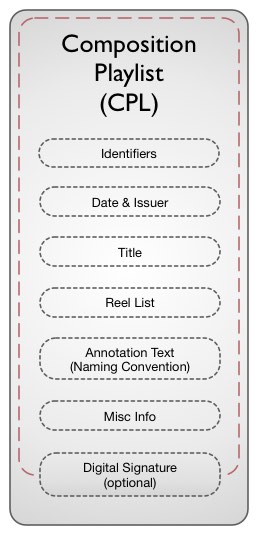
Figure CPL-1. The Composition Playlist (CPL)
The CPL is an XML data file whose metadata defines the Composition that it represents. A description of the CPL’s data elements is presented below:
| Composition Playlist (CPL) Element | Description |
| CPL Identifier | Identifies this instance of the Composition, encoded as a Universally Unique IDentifier (UUID) per RFC 4122 |
| Content Version Identifier | Identifies the version of content of which this Composition is an instance, encoded as a Universally Unique IDentifier (UUID) |
| Reel List | A list by Reel of the Track File assets to be reproduced, in the order they are to be played |
| Content Title Text | Title of the work |
| Annotation Text | Text field, typically defined by the Digital Cinema Naming Convention |
| Content Kind | An attribute naming the type of content in the Composition per SMPTE 429-7 |
| Rating | An agency rating of this work. In the US, this would be an MPAA rating |
| Issue Date | Time and date when the CPL was issued |
| Issuer | Optional text field naming the issuer |
| Creator | Optional text field identifying the application used to create the Composition |
| Signer | If digitally signed, this carries the public key of the entity that signed the CPL |
| Digital Signature | Optional, used to authenticate the CPL |
Table CPL-1. Composition Playlist (CPL) Data Elements
For a complete description of the SMPTE CPL, please refer to SMPTE S429-7 Composition Playlist. The top-level document that defines the DCP and Composition is SMPTE ST 429-2 DCP Operational Constraints.
The CPL carries metadata that describes the Composition, but in practice, more data is needed to benefit cinema operators. An ad-hoc nomenclature is often used for this purpose called the Digital Cinema Naming Convention. The Naming Convention prescribes a human-readable text field carried by the CPL Annotation Text element. It was devised as a stop-gap measure until a means to include additional metadata in the Composition was devised. A standard that accomplishes this is now available, titled ST 429-16 Additional Composition Metadata and Guidelines.